Neuro Vision OV5640 Getting Started
The Neuro Vision OV5640 camera module with the 5 MP autofocus sensor, strobe LED and time of flight sensor, and the OV5640-W variant that adds the wireless module.
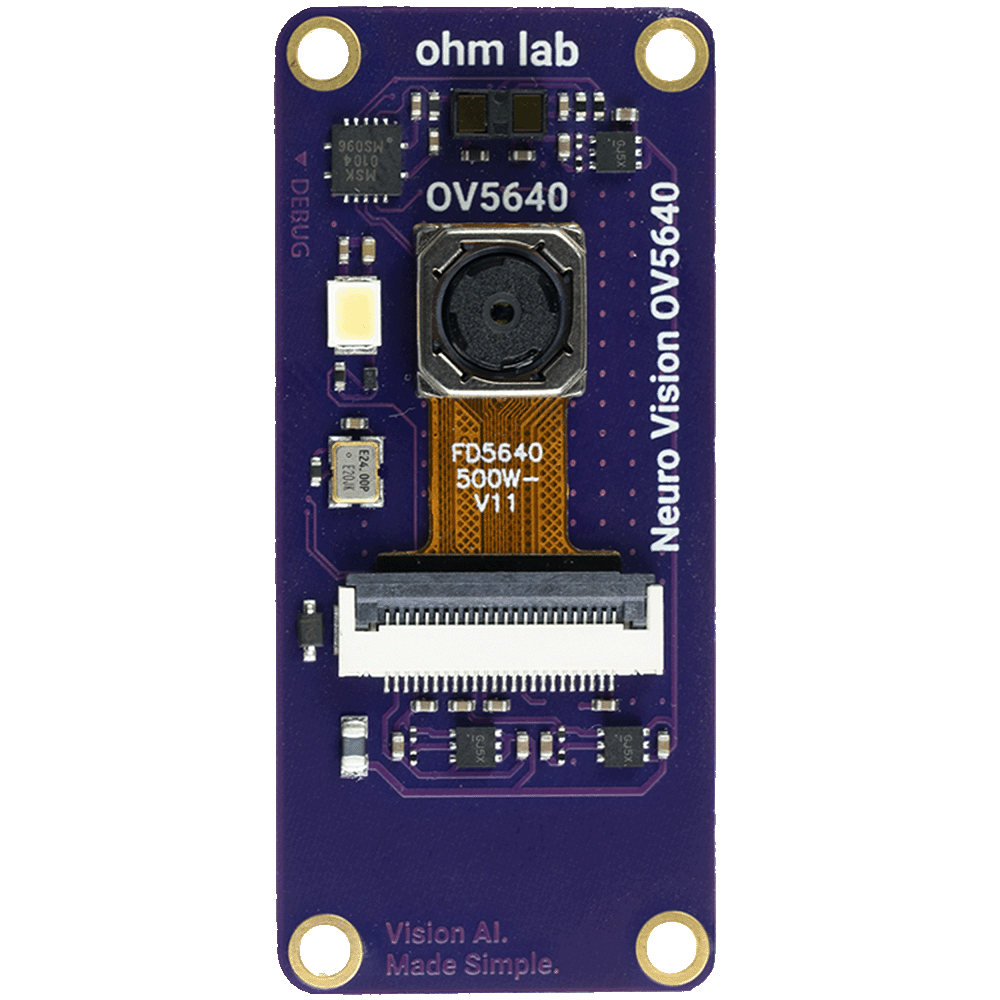
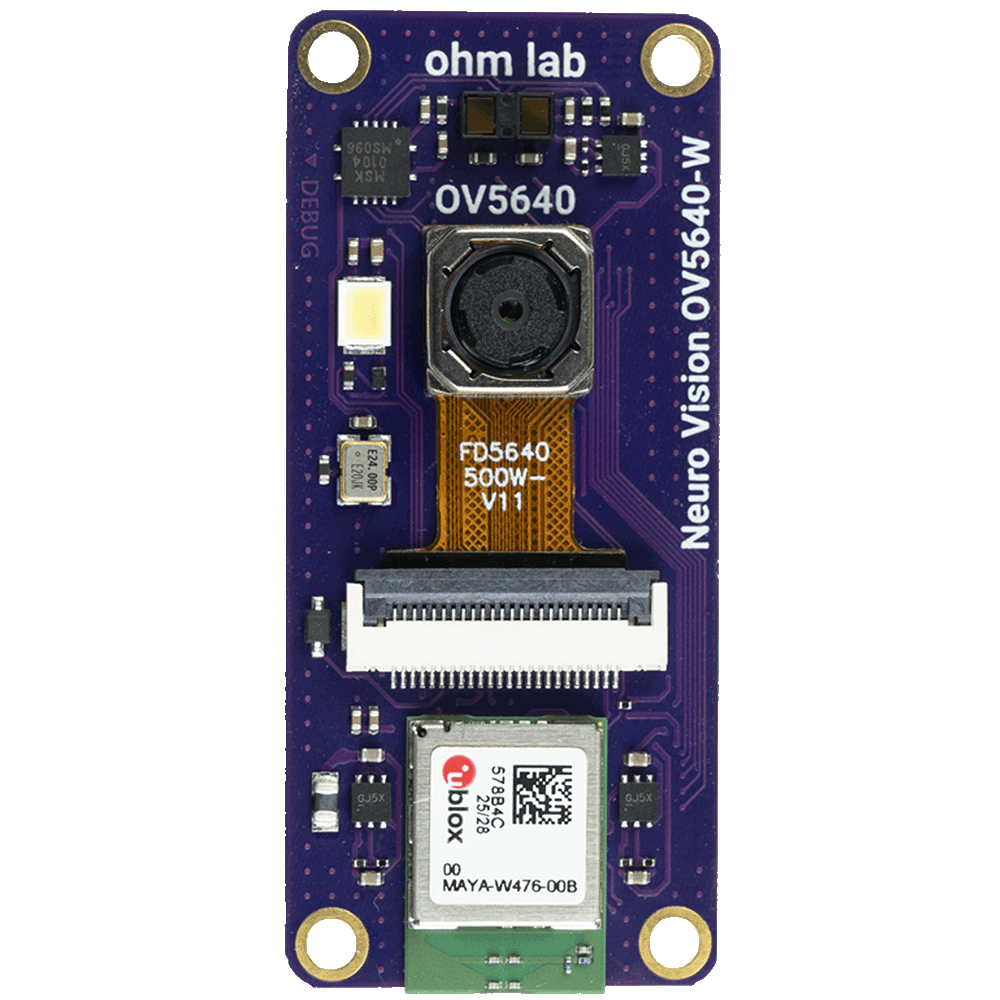
The Neuro Vision OV5640 is a camera module for the Neuro N6 built around the OmniVision OV5640 image sensor, a 5 megapixel rolling shutter sensor with an on-chip autofocus coprocessor and a voice coil lens. The module carries a strobe LED on the sensor's strobe output and a VL53L1CB time of flight sensor. The Neuro Vision OV5640-W is the same module with a u-blox MAYA-W476 WiFi and Bluetooth LE module added.
Specifications
| OV5640 | OV5640-W | |
|---|---|---|
| Sensor | OmniVision OV5640, 1/4 inch, 2592x1944, rolling shutter | Same |
| Lens | Autofocus, voice coil, on-chip focus coprocessor | Same |
| Interface | Two-lane MIPI CSI-2, up to 60 fps at 800x480 and about 14 fps at 5 MP | Same |
| Output format | YUV 4:2:2, processed on the sensor with automatic exposure, gain and white balance | Same |
| Strobe LED | On the sensor strobe output, pulsed with exposure | Same |
| Time of flight | ST VL53L1CB, 4x4 zones, on the module I2C bus at 0x29 | Same |
| Wireless | None | u-blox MAYA-W476 (NXP IW610): WiFi 2.4 GHz 802.11 b/g/n/ax and Bluetooth LE, over SDIO and UART |
| Display | None | None |
| Carrier wiring | Physical CSI lane order | Same |
| Part number | OL-DEV-N6-002, hardware revision B | OL-DEV-N6-003, hardware revision B |
The inertial unit, magnetometer and microphone are on the Neuro N6 board itself and are available with every module.
Circuit
The OV5640 sensor is a 24-pin flexible printed circuit module seated in an FPC connector on the carrier. A 24 MHz oscillator supplies its clock. Three BCT2057 low dropout regulators produce the sensor's 2.8 V and 1.5 V supplies and a separate 2.8 V supply for the time of flight sensor from the Neuro N6's 3.3 V rail. An MTXS0104 level shifter translates the I2C bus between the Neuro N6's 3.3 V and the sensors' 1.8 V. The strobe LED is a white XL-2835 driven by a transistor from the sensor's strobe output. The carrier mates through the 30-pin and 40-pin board-to-board connectors, and the OV5640-W adds the MAYA-W476 module on its own sheet, connected over SDIO for WiFi and the four-wire UART for Bluetooth. Both schematics are published under CERN-OHL-S v2; see Downloads.
Fitting
The module mates with the two board-to-board connectors on the Neuro N6 with the board unpowered.
In a sketch
Both variants are declared without a carrier argument:
#include <OV5640_Arduino.h>

OV5640 camera;
The CameraStream example, under File > Examples > NeuroN6Examples > 02.Camera, streams the sensor to Neuro Studio. See Streaming the Camera.
Camera modes
| Mode | Pixels | Maximum frame rate |
|---|---|---|
| VGA | 640x480 | 60 |
| WVGA | 800x480 | 60 |
| XGA | 1024x768 | 30 |
| 720p | 1280x720 | 30 |
| 1080p | 1920x1080 | 30 |
| QSXGA | 2592x1944 | about 14 |
See Resolutions and Frame Rates.
Autofocus, strobe and controls
Autofocus is set with cfg.af at start or camera.autoFocus() at run time. The strobe LED is enabled with cfg.strobe = STROBE_ENABLED. Exposure, gain and white balance can be locked or set explicitly, and Neuro Studio shows a Camera Controls panel for them. See Capture Controls.
Time of flight sensor
The VL53L1CB is read through the VL53L1CB library as a 4x4 grid of distances in millimetres. See On-board Sensors.
Wireless (OV5640-W)
The MAYA-W476 streams video to Neuro Studio over WiFi in place of USB and provides Bluetooth LE. The module firmware is flashed to the board by the Arduino uploader on the first upload of a wireless sketch. On the OV5640 without the module, a WiFi transport falls back to USB with a console warning. See WiFi and Bluetooth LE.
Module comparison
| Module | Sensor | Strobe LED | ToF | Display, touch, speaker | Wireless |
|---|---|---|---|---|---|
| Neuro Vision OV5640 | OV5640 | Yes | Yes | No | No |
| Neuro Vision OV5640-W | OV5640 | Yes | Yes | No | Yes |
| Neuro Vision TFT | OV5640 | Yes | Yes | Yes | No |
| Neuro Vision TFT-W | OV5640 | Yes | Yes | Yes | Yes |
| Neuro Vision STCam | VD66GY | Yes | Yes | No | No |
| Neuro Vision Thermal | VD66GY and FLIR Lepton | No | No | No | No |